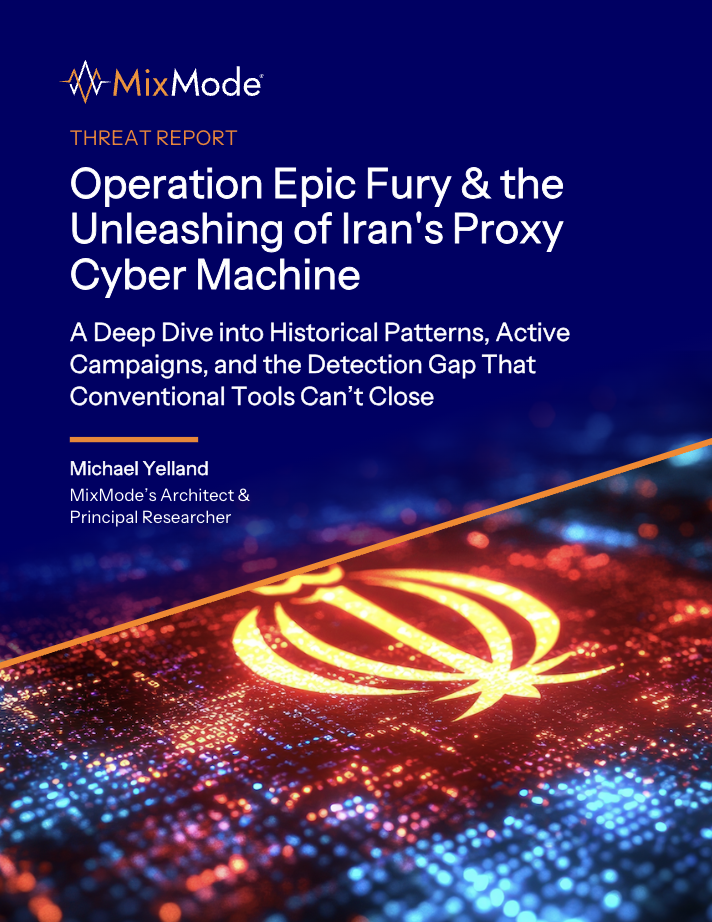

Operation Epic Fury & the New Reality of Cyber Conflict

On February 28, 2026, a geopolitical flashpoint reshaped the cyber threat landscape overnight.
Following coordinated U.S. and Israeli strikes on Iran’s IRGC command infrastructure, Iran’s centralized cyber capabilities were temporarily disrupted. But what emerged in its place is far more complex and far more dangerous: a decentralized, fast-moving network of proxy actors operating without constraint, without coordination bottlenecks, and without historical detection baselines.
This is not just an escalation. It is a shift in how modern cyber campaigns are executed.
Download the full Threat Research Report

From Doctrine to Deployment: 15 Years in the Making
To understand what’s happening now, you have to look back.
Iran’s cyber strategy has evolved over more than a decade, moving from reactive retaliation to deliberate pre-positioning inside critical systems. Early destructive attacks gave way to long-term espionage. That espionage evolved into infrastructure targeting. And more recently, into a distributed proxy ecosystem designed to scale operations while obscuring attribution.
What we’re seeing today is the culmination of that evolution.
A campaign that blends:
- Pre-staged access from sophisticated state actors
- Active operations from intelligence-linked groups
- Regional proxy cells operating at high tempo
- Hacktivist networks generating volume and noise at scale
Each layer introduces a different type of risk. Together, they create a threat environment that is harder to track, harder to attribute, and significantly harder to detect.
A Surge in Activity Across Critical Sectors
Since early March, activity tied to Iran-aligned actors has spanned healthcare, energy, aviation, government systems, and financial services across multiple regions.
The scale and speed matter.
This is not a single coordinated attack. It is a distributed campaign unfolding across geographies and sectors simultaneously. Some incidents are confirmed. Others are claimed. New activity is emerging daily.
What’s clear is this: critical infrastructure is not incidental to this campaign. It is a primary target.
The Risk Isn’t New. The Conditions Are.
Many of the vulnerabilities being leveraged right now are not new discoveries.
Industrial control systems, including those used in water and energy environments, have already been identified as exposed in prior campaigns. In some cases, those exposures remain unaddressed.
What has changed is the context.
Previously, these vulnerabilities existed within a more controlled operational environment. Today, they are being targeted by a broader, less predictable set of actors operating at higher speed and scale.
That shift dramatically increases risk.
The Detection Problem No One Can Ignore
What makes this campaign particularly challenging is not just who is involved, but how they are operating.
Many of the active threat actors:
- Have no prior signature or known indicators
- Are leveraging infrastructure associated with cybercrime to mask attribution
- Are reactivating dormant access established months or years ago
- Are blending command-and-control activity into legitimate cloud traffic
This creates a fundamental detection gap.
Traditional tools, built to identify known threats or previously observed patterns, struggle in an environment where:
- The actors are new
- The infrastructure is constantly shifting
- The activity is intentionally designed to look normal
In other words, the signals most security teams rely on may not exist.
A Shift in Defensive Posture
At the same time, organizations are navigating this threat environment with reduced external support. Federal coordination capacity is constrained, and response timelines are tightening.
The result is a growing need for organizations to operate more independently when it comes to detection and response.
That starts with visibility.
Not just into known threats, but into the subtle deviations that indicate something new is happening inside the network.
Why This Moment Matters
Operation Epic Fury did not create Iran’s cyber capability. It accelerated it.
By removing centralized constraints, it unleashed a distributed ecosystem that is faster, less predictable, and more difficult to detect than anything seen in prior campaigns.
For security teams, this represents a critical inflection point.
The question is no longer just how to defend against known threats.
It’s how to detect what hasn’t been seen before.
Go Deeper: Access the Full Threat Research Report
This blog only scratches the surface.
The full MixMode Threat Research Report breaks down:
- The full evolution of Iranian cyber doctrine
- Detailed analysis of active threat actors and campaigns
- Real-world incidents and target profiles
- The specific detection challenges facing enterprise and critical infrastructure environments
Immediate actions organizations should take right now